


Amino acid sequences and properties of CPPs
Tat, GRKKRRQRRRPPQQ or GRKKRRQRRRPQ, the transcription activator of the human immunodeficiency virus type 1 (HIV-1) viral genome, enters cells in a non-toxic and highly efficient manner. Tat is the first known cell-penetrating peptide. More about pI, sequence, and structures of HS-binding cell penetrating peptides.
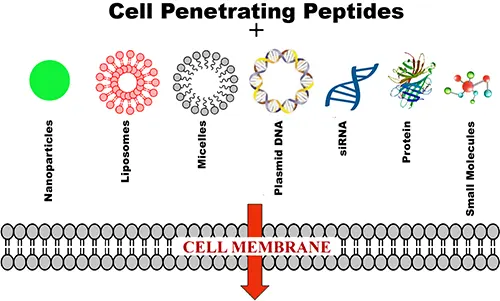
CPPs have been used as a carrier to deliver proteins or genes into cells and tissues. In this study, a CPP library composed of 55 CPPs were used to deliver genes into plant cells. Many CPPs showed efficient penetration into plant cells. The Lys-containing CPPs have higher penetration efficiency in the plant than in animal cells. This could be due to differences in lipid composition and surface charge of the cell membranes. No correlations were detected between the penetration efficiency and the cationic, amphipathic, or hydrophobic properties of peptides.
D-R9 is composed of D-form amino acids. D-R9 bound preferentially to the membrane and did not penetrate the cytosol or vacuole. In mammalian cells, poly-Lysine-based CPPs are efficient and interact with membrane lipid head groups to induce wrapping of the membrane monolayers. Arg-rich peptides, such as the Tat peptide, are among the most efficient CPPs. Arg-rich CPPs may generate negative Gaussian membrane curvature to form pores or protrusions from endocytosis. The cell penetration efficiency of CPPs containing poly-Arg is higher than those containing poly-Lys. However, in the plant, Arg-rich CPPs are not the most efficient at penetrating plant cell.
Download the full list HERE!
| Peptide No. | CPP | Amino acid sequence | Number of amino acids | CPP type: C: cationic, A: amphipathic, H: hydrophobic. | Net charge at pH7 |
|---|---|---|---|---|---|
| 1 | BP100 | KKLFKKILKYL | 11 | A | 5 |
| R9-BP100 | RRRRRRRRRKKLFKKILKYL-NH2 | 20 | C | 15 | |
| 2 | 2BP100 | KKLFKKILKY LKKLFKKILK YL | 22 | C | 10 |
| 3 | Rev(34–50) | TRQARRNRRR RWRERQR | 17 | C | 9 |
| 4 | R9 | RRRRRRRRR | 9 | C | 9 |
| 5 | D-R9 | rrrrrrrrr (D form) | 9 | C | 9 |
| 6 | R12 | RRRRR RRRRR RR | 12 | C | 12 |
| 7 | KH9 | KHKHKHKHKH KHKHKHKH | 18 | C | 9.9 |
| 8 | K9 | KKKKKKKKK | 9 | C | 9 |
| 9 | K18 | KKKKK KKKKK KKKKK KKK | 18 | C | 18 |
| 10 | Pen2W2F | RQIKI FFQNR RMKFKK | 16 | C | 7 |
| 11 | DPV3 | RKKRR RESRK KRRRES | 16 | C | 10 |
| 12 | 6-Oct | GRKRKKRT | 8 | C | 6 |
| 13 | R9-TAT | GRRRR RRRRR PPQ | 13 | C | 9 |
| 14 | Tat(49–57) | RKKRRQRRR | 9 | C | 8 |
| 15 | Retro - Tat(57–49) | RRRQRRKKR | 9 | C | 8 |
| 16 | Sc18 | GLRKRLRKFR NKIKEK | 16 | A | 8 |
| 17 | KLA10 | KALKKLLAKW LAAAKALL | 18 | A | 5 |
| 18 | IX | QLALQLALQA LQAALQLA | 18 | H | 0 |
| 19 | XI | LKTLATALTK LAKTLTTL | 18 | H | 3 |
| 20 | No. 14–12 | RAWMRWYSPT TRRYG | 15 | A | 4 |
| 21 | pVEC | LLIILRRRIR KQAHAHSK | 18 | A | 6.2 |
| 22 | PenArg | RQIRIWFQNR RMRWRR | 16 | A | 7 |
| 23 | M918 | MVTVLFRRLR IRRACGPPRV RV | 22 | A | 6.9 |
| 24 | Penetratin | RQIKI WFQNR RMKWK K | 16 | A | 7 |
| 25 | PolyP 3 (SAP) | VRLPP PVRLP PPVRL PPP | 18 | H | 3 |
| 26 | dhvar5 | LLLFL LKKRK KRKY | 14 | A | 7 |
| 27 | HPV33L2-445/467 | SYFIL RRRRK RFPYF FTDVR VAA | 23 | A | 6 |
| 28 | buforin II (5–21) | RAGLQ FPVGR VHRLL RK | 17 | A | 5.1 |
| 29 | scrambled pVEC | IAARI KLRSR QHIKL RHL | 18 | A | 6.2 |
| 30 | HPV33L2-DD447 | SYDDL RRRRK RFPYF FTDVR VAA | 23 | A | 4 |
| 31 | LAH4 | KKALL ALALH HLAHL ALHLA LALKKA | 26 | H | 4.4 |
| 32 | ppTG1 | GLFKA LLKLL KSLWK LLLKA | 20 | A | 5 |
| 33 | Transportan (TP) | GWTLN SAGYL LGKIN LKALA ALAKK IL | 27 | H | 4 |
| 34 | 2×ppTG1 | GLFKA LLKLL KSLWK LLLKA GLFKA LLKLL KSLWKLLLKA | 40 | A | 10 |
| 35 | pAntpHD(Pro50) | RQIKI WFPNR RMKWKK | 16 | A | 7 |
| 36 | pAntp(44–58) | QIKIW FQNRR MKWKK | 15 | A | 6 |
| 37 | Crot(27–39) | KMDCR WRWKC CKK | 13 | A | 4.8 |
| 38 | Crot(27–39) derevative (1) | MDCRW RWKCC KK | 12 | A | 3.8 |
| 39 | Crot(27–39) derevative (2) | KCGCR WRWKC GCKK | 14 | A | 5.7 |
| 40 | CyLoP-1 | CRWRW KCCKK | 10 | A | 4.8 |
| 41 | Inv3 | TKRRI TPKDV IDVRS VTTEI NT | 22 | H | 2 |
| 42 | Inv5 | AEKVD PVKLN LTLSA AAEAL TGLGD K | 26 | H | -1 |
| 43 | Inv3.5 | TKRRI TPKDV IDVRS VTTKI NT | 22 | H | 4 |
| 44 | Inv3.10 | HHHHHH TKRRITPK DVIDVRSVTTEINT | 28 | H | 2.6 |
| 45 | ARF(1–22) | MVRRF LVTLR IRRAC GPPRV RV | 22 | A | 6.9 |
| 46 | Cyt C 77–101 | GTKMI FVGIK KKEER ADLIA YLKKA | 25 | A | 4 |
| 47 | hLF peptide | KCFQWQRNM RKVRGPPVSCIKR | 22 | A | 6.9 |
| 48 | Glu-Oct-6 | EEEAA GRKRKKRT | 13 | A | 3 |
| 49 | M511 | FLGKK FKKYF LQLLK | 15 | A | 5 |
| 50 | G53-4 | FLIFI RVICI VIAKL KANLM CKT | 23 | H | 3.9 |
| 51 | M591 | YIVLR RRRKR VNTKRS | 16 | A | 8 |
| 52 | E162 | KTVLL RKLLK LLVRKI | 16 | A | 6 |
| 53 | E165 | LLKKR KVVRL IKFLLK | 16 | A | 7 |
| 54 | M867 | KKICT RKPRF MSAWAQ | 16 | A | 4.9 |
| 55 | MG2d | GIGKFLHSAKK WGKAFVGQIMNC | 23 | H | 4 |
| 56 | Antitrypsin (358-374) | CSIPP EVKFN KPFVYLI | 17 | H | 0.9 |
| 57 | BAC715-24 | PRPLPFPRPG | 10 | A | 2 |
| 58 | BMV Gag-(7-25) | KMTRA QRRAA ARRNR WTAR | 19 | C | 8 |
| 59 | BUFORIN II | TRSSR AGLQF PVGRV HRLLRK | 21 | A | 6.1 |
| 60 | CADY | Ac-GLWRA LWRLL RSLWR LLWRA-cysteamide | 21 | H | 4 |
| 61 | CCMV Gag-(7-25) | KLRTR AQRRA AARKN KRNTR | 20 | C | 10 |
| 62 | ARF Peptide (26-44) | H-D-Arg-D-Arg-D-Arg-D-Arg-D-Arg -D-Arg-D-Arg-D-Arg-D-Arg-Lys -Phe-Val-Arg-Arg-Ser -Arg-Arg-Pro-Arg-Thr- Ala-Ser-Cys-Ala-Leu- Ala-Phe-Val-Asn-OH | 29 | A | 14.9 |
| 63 | FHV COAT-(35-49) | RRRRN RTRRN RRRVR | 15 | C | 11 |
| 64 | Calcitonin | LGTYT QDFNK FHTFP QTAIG VGAP | 24 | H | 0.1 |
| 65 | HN-1 | TSPLNIHNGQKL | 12 | H | 1.1 |
| 66 | HTLV-II Rex-(4-16) | TRRQRTRRARRNR | 13 | C | 8 |
| 67 | Human P: | MGLGL HLLVL AAALQ GAWSQ PKKKRKV | 27 | H | 5.1 |
| 68 | Human P | MGLGL HLLVL AAALQ GAWSQ PKKKRKV | 27 | H | 5.1 |
| 69 | K-FGF | AAVAL LPAVL LALLAP | 16 | H | 0 |
| 70 | Ku70 | VPMLKPMLKE | 10 | A | 1 |
| 71 | MAP | KLALKLALHA LKAALKLAKL ALKLALKALK AALKLA-NH2 | 36 | H | 10.1 |
| 72 | Maurocalcine | GDC(acm)LP HLKLC | 10 | H | 0 |
| 73 | Neurturin | GAAEA AARVY DLGLR RLRQR RRLRR ERVRA | 30 | A | 8 |
Other examples are:
Download the full list HERE!
Quotations