


Custom MAP peptides, branched lysine-core peptides, peptide dendrimers, dendrons, and multi-epitope peptide immunogens for antibody production and vaccine research.
LifeTein provides custom multiple antigenic peptide (MAP) synthesis services for researchers who need high-density peptide antigens without traditional carrier-protein conjugation. MAP peptides are branched peptide constructs, typically built on a lysine-based core, that display multiple copies of the same or different peptide epitope.
MAP designs are widely used for polyclonal antibody production, peptide vaccine research, epitope presentation, immune-response studies, diagnostic assay development, and peptide-protein interaction studies.

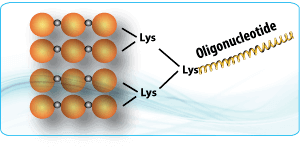
Multiple Antigenic Peptides, or MAPs, are dendritic peptide structures in which several peptide chains are attached to a branched lysine scaffold. A typical MAP contains four or eight copies of a peptide epitope displayed from a central lysine core.
This multivalent structure increases the apparent molecular weight and antigen density of the peptide immunogen. Because the peptide epitope represents a high percentage of the final MAP molecule, MAPs can often stimulate antibody production without requiring KLH, BSA, or another carrier protein.
| MAP Format | Typical Use | Notes |
|---|---|---|
| MAP-4 | Four copies of one peptide epitope | Commonly used for antibody production; often preferred for longer epitopes |
| MAP-8 | Eight copies of one peptide epitope | Higher epitope density; often useful for shorter epitopes |
| Multi-epitope MAP | Different peptide epitopes on one branched scaffold | Useful for vaccine research or multi-site antibody studies |
| Lipidated MAP | MAP with lipid or palmitic acid modification | Can support immune presentation or self-assembly studies |
| MAP-conjugate | MAP linked to oligo, dye, biotin, or other cargo | Used for specialized detection, delivery, or binding assays |
The best MAP design depends on epitope length, solubility, synthesis difficulty, and intended application.
LifeTein can help evaluate whether MAP-4, MAP-8, KLH conjugation, or another peptide antigen format is best for your antibody project.
MAP peptides are popular for antibody production because they present multiple copies of the antigenic peptide in one molecule. This high epitope density can improve immune recognition and avoids the need for a large carrier protein in many projects.
| Feature | MAP Peptide | KLH-Conjugated Peptide |
|---|---|---|
| Carrier protein | Usually not required | Requires KLH or another carrier |
| Antigen density | High peptide density on lysine core | Depends on conjugation efficiency |
| Defined structure | More compositionally defined | More heterogeneous conjugate mixture |
| Best for | Peptide antibody projects, multi-copy epitope display | Very small or weakly immunogenic peptides, routine immunization |
| Potential limitation | Aggregation or difficult purification for some sequences | Carrier-directed immune response and conjugation variability |
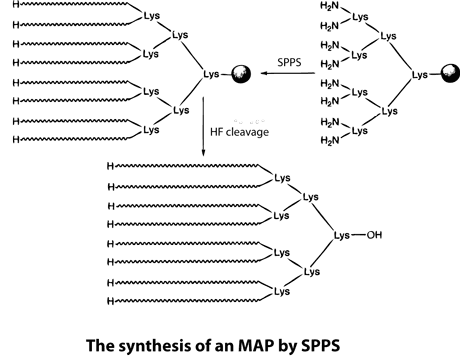
MAP peptides can be synthesized by direct solid-phase peptide synthesis or by assembling purified peptide branches onto a branched core through chemical ligation. The preferred route depends on peptide length, sequence complexity, number of branches, and required purity.
In the direct approach, the peptide branches are elongated from a lysine-core resin. This method is efficient and cost-effective for many MAP-4 and MAP-8 designs.
For difficult MAPs, especially those with long, hydrophobic, or complex peptide branches, chemical ligation can improve control over product quality. In this approach, peptide branches are synthesized and purified first, then assembled onto the branched scaffold.

MAP peptides are more challenging than standard linear peptides because multiple peptide chains are synthesized or assembled on one scaffold. As the branches grow, steric crowding and aggregation can reduce coupling efficiency and increase deletion products.
LifeTein evaluates MAP peptide projects for:
A spacer can improve epitope accessibility and reduce steric hindrance between the lysine core and peptide branches. Common spacer options include:
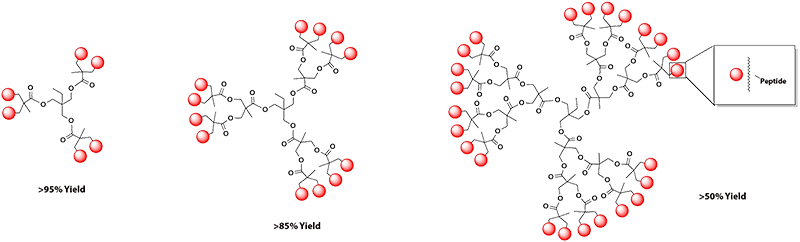
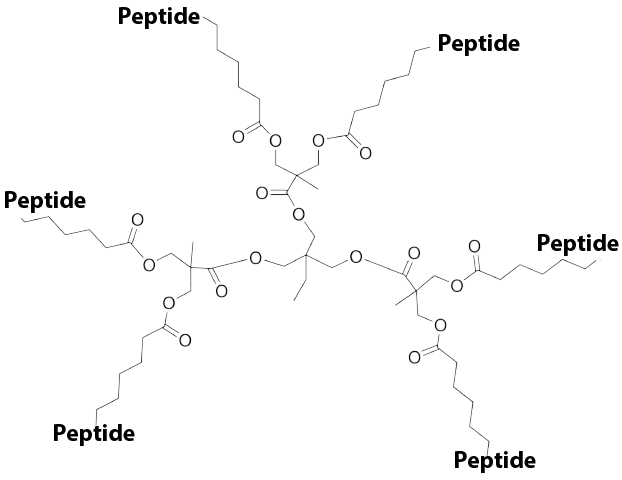
In addition to classical MAP antigens, LifeTein provides peptide dendrimer and dendron synthesis services. Peptide dendrimers are branched macromolecules that can display multiple functional peptide units, charged groups, targeting ligands, or cell-penetrating sequences.
Dendrons are wedge-shaped branched structures with a single focal reactive point. They are useful when a branched peptide structure must be conjugated to another molecule, surface, nanoparticle, oligonucleotide, lipid, or protein.
LifeTein MAP peptides have been used in published antibody and immunology research. Recent studies continue to use MAP-4 systems because they can present multiple copies of a peptide epitope without requiring a carrier protein.
Please send your peptide epitope sequence, desired MAP format, branch number, spacer preference, purity, quantity, and application. For antibody production, please also tell us the target species, immunization plan, and whether you need matched linear or control peptides.