Modifications: N-Terminal Acetylation and C-Terminal Amidation
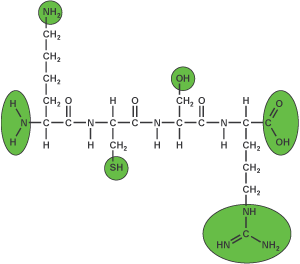
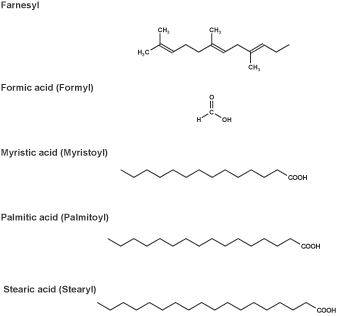
Peptides can be modified at the N terminus, in the middle, or at the C terminus. In general, some standard peptide moieties must be accessible in order to be modified: an N-terminal amino group, the amino group of Lys, the thiol group of Cys, the hydroxyl groups of Ser, Thr, and Tyr, the C=NH group of Arg, and the C-terminal carboxyl group.
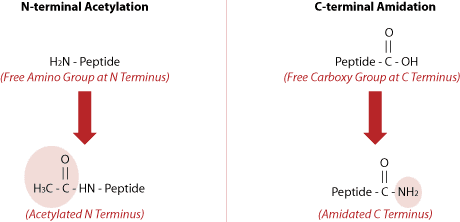
Free Modifications: N-Terminal Acetylation and C-Terminal Amidation
Chemically synthesized peptides have free N- and C-termini. Please state any need for N-terminal acetylation or C-terminal amidation during the ordering process because it is impossible to perform these modifications after synthesis.
N-terminal acetylation and C-terminal amidation reduce the overall charge of a peptide; therefore, its overall solubility might decrease. However, the stability of the peptide could also be increased because the terminal acetylation/amidation generates a closer mimic of the native protein. Therefore, these modifications might increase the biological activity of a peptide.
Advantages:
The altered peptide ends are uncharged, so the modified peptides more closely mimic the native protein. This increases their ability to enter cells. We recommend this modification for intracellular experiments, in vivo assays, and in vitro functional studies.
The modifications increase the metabolic stability of peptides as well as their ability to resist enzymatic degradation by aminopetidases, exopeptidases, and synthetases. The modified peptides can then be used as substrates in enzyme assays.
Amidation not only enhances the activity of peptide hormones, but also prolongs their shelf life.
The changes reduce the effect of charged C- or N-termini during ELISA binding.
Reference: The laboratory of Michael Forma has been acetylating and amidating their blocker peptide and describing the benefits for several years. In one such publication (Biophysical Journal Volume 95 November 2008 4879–4889, Figure 2), they described the advantages of using these modifications to improve the blocking efficiency. Figure 2 in this publication provides a convincing experimental argument to suggest that the acetylating the N-terminus and amidating the C-terminus improved the channel blocking efficiency of their peptides.
We use essential cookies to make our site work. With your consent, we may also use non-essential cookies to improve user experience and analyze website traffic.
You can accept all cookies or continue with essential cookies only. See our
Cookie Policy.