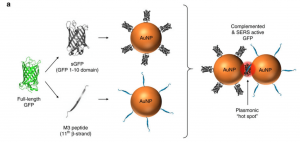
Noble metal gold (Au) and silver (Ag) nanoparticles (NPs) are used to conjugate with M3 peptides. The AuNPs-sGFP and AuNPs-M3 peptide forms an active SERS hot spot through self-assembly and GFP complementation. The nanoparticles self-assemble into surface-enhanced Raman-scattering (SERS) nanoclusters. The nanocluster can be a contrast agent for multimodal SERS and photoacoustic microscopy with single-cell sensitivity.
AuNPs coated with M3 peptides-GFP
Reference: M3 peptide was purchased from LifeTein.
Cellular imaging by targeted assembly of hot-spot SERS and photoacoustic nanoprobes using split-fluorescent protein scaffolds
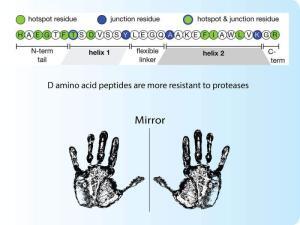
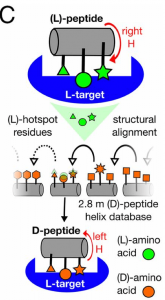
Using D-amino acids as the building blocks for bioactive peptides can dramatically increase their potency. In this study, the authors generated a database of ∼2.8 million D-peptides using a mirror image of every structure in the Protein Data Bank (PDB). The critical or hotspot residues were studied. Residues critical to target binding and activity can be ideally done experimentally, such as by alanine scanning mutagenesis. It can also be done computationally through thermodynamic integration or free energy perturbation.
D-Amino Acids for Bioactive Peptides
Two peptides were tested to prove the concept: GLP-1 and Parathyroid Hormone. Both (L)- and (D)-peptides were synthesized by Lifetein LLC.
GLP-1 is a helical GPCR agonist as a diabetes mellitus and obesity treatment. Hotspot and junction residues are annotated in green and blue, respectively. The authors investigated the ability of (D)-GLP1 peptide to induce activation of GLP1R and compared the response with native (L)-GLP1 peptide. It was found that the D-GLP-1 performed well and was resistant to protease degradation. The retro-inversion (RI) reversing the (D)-peptide sequence was used in the experiment.
2. Parathyroid Hormone (PTH) is an FDA-approved treatment for osteoporosis. The (D)-PTH activates PTH1R with potency and efficacy comparable to (L)-PTH. And more than 85% of the (D)-PTH analog is still detectable at six hours.
PTH 1-34: SVSEIQLMHNLGKHLNSMERVEWLRKKLQDVHNF
Conclusion: The D-Protein Data Bank (PDB) can be used to search and find therapeutically active topologies. The D-PDB could be a vital tool for finding stable lead molecules in early-stage drug discovery.
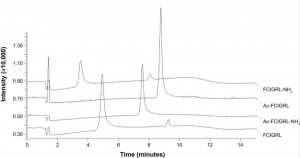
Zonula occludens toxin (Zot) and its biologically active fragment, delta G, have been shown to reversibly open tight junctions (TJ) in endothelial and epithelial cells. AT1002, a six-mer synthetic peptide H-FCIGRL-OH of ZO toxin, was identified and synthesized to retain the Zot permeating effect on intercellular TJ. It was found that AT1002 disrupts the epithelial barrier while larazotide acetate restores barrier function by rearrangement of actin. In addition, AT1002 enhances the transport of molecular weight markers or agents with low bioavailability with no cytotoxicity. So, this synthetic peptide AT1002 is a tight junction modulator with promising permeation-enhancing activity.
A Synthetic Peptide Showed Enhanced Nasal Drug Delivery
The C-terminal amidated AT1002 FCIGRL-NH2 showed enhanced nasal drug delivery and may lead to the development of a practical drug delivery technology for drugs with low bioavailability.
LifeTein synthesized the synthetic peptide AT1002.
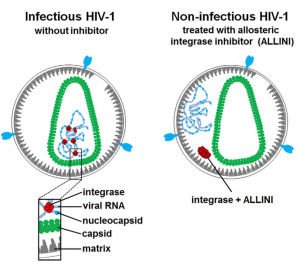
It was found that the HIV-1 Integrase binds the Viral RNA genome and is essential during Virion Morphogenesis. The L50 Peptide: Cyclo-(-Arg-Val-Arg-Thr-Arg-Gly-LysArg-Arg-Ile-Arg-Arg-DPro-Pro-) was synthesized by LifeTein and used for the inhibition assays. The L50 is a Tat-derived peptide sequence, which selectively engages both the loop and 3-nt bulge but not the double-stranded stem of the transactivation response. The TAT-derived peptide is a well-defined cell penetration peptide.
The SrtA substrates Biotin–aminohexanoic acid–LPETGS and SELPETGG were used to interact with immune cells ‘Labelling Immune Partnerships by SorTagging Intercellular Contacts’ (LIPSTIC). The peptide-receptor interactions enable the direct measurement of dynamic cell-cell interactions. The peptides are flexible tools with different receptor-ligand pairs and a range of detectable labels.
How does the amino acid sequence of a protein chain determine and maintain its 3D folded state? How do small proteins fold?
Short Peptide Folding
Many small proteins or miniproteins are peptides shorter than 40-50 residues with stable folding that contain secondary structure elements such as alpha helices and beta strands.
An autonomously folding, 35-residue, thermostable subdomain (HP36) of the villain headpiece is the smallest folded domain of a naturally occurring protein. Polypeptides simplify the protein-folding problem. They allow in-depth examinations of sequence-structure-stability relationships without using the complex larger proteins.
In this recent study, Rocklin et al. designed sequences intended to fold into desired structures. The novel proteins may be helpful in bioengineering or pharmacological applications.
LifeTein is unveiling an expedited peptide synthesis program, promising to place peptides in its customers’ hands within 3-5 business days. The RushPep™ peptide synthesis service was designed to circumvent the existing limitations of conventional solid-phase peptide synthesis (SPPS), which involves a long coupling time and low yield. RushPep™ shortens the time needed for individual coupling, deprotection, and washing steps. The proprietary methodology renders processing ten times faster than in classical synthesis while circumventing the limitations caused by forming by-products or intermediates to which traditional SPPS approaches are subject.
LifeTein’s Rush Custom Peptide Synthesis Service
“When designing the RushPep™ methodology, our focus was not only to produce peptides of high quality and purity but also to offer a streamlined solution that would increase the efficiency of researchers’ protein discovery workflows,” stated Dr. Ya Chen, Head of LifeTein’s Rush Peptide Synthesis Group. “RushPep™ achieves these goals by synthesizing the peptides in 3–5 business days to accelerate research and discovery.”
Chen continued, “The reliability of RushPep™ rush peptide synthesis ensures that the peptides are finished in 3–5 business days with high-batch-to-batch reproducibility. ” Most of the crude peptides have a purity of over 80%. RushPep™ peptide service is valuable for scientists and researchers because it allows them to finish their proteomics projects quickly and cost-effectively.
LifeTein synthesized all peptides used in this study for Parkinson’s disease. α-synuclein is an indication of the pathogenesis of Parkinson’s disease. It was found that a molecular mimicry mechanism between HSV1 and human α-synuclein could trigger PD.
Biotinylated wild-type and modified (pT27 and T27W) ID2 peptides (amino acids 14–34) were synthesized by LifeTein. ID2 binds to the VHL ubiquitin ligase complex. This ID2 peptide could be used to inhibit tumor growth in patients with glioblastoma.
The anti-apoptotic factor Bcl-2 is over-expressed in B-cell lymphoma cells as their primary survival mechanism by binding to IP3R2 on the endoplasmic reticulum (ER). In this study, a cell-penetrating version of the BIRD-2 peptide (Bcl-2/IP3R Disrupter-2 peptide with a TAT sequence) made by LifeTein was used to break up the complex formed by Bcl-2 and IP3R2 in human diffuse large B-cell lymphoma (DLBCL) cells. Ca2+ signaling-related events are suggested to be the killing mechanism of BIRD-2 peptide on DLBCL cells.
BIRD-2, a peptide that explicitly disrupts the Bcl2/IP3R complex, was utilized to further verify the mitochondrial Ca2+ regulatory mechanism via the Bmal1-Bcl2/IP3R signaling pathway. It was found that BIRD-2 aggravated mitochondrial Ca2+overload and apoptosis in vitro.
To provide the best experiences, we use technologies like cookies to store and/or access device information. Consenting to these technologies will allow us to process data such as browsing behavior or unique IDs on this site. Not consenting or withdrawing consent, may adversely affect certain features and functions.
Functional
Always active
The technical storage or access is strictly necessary for the legitimate purpose of enabling the use of a specific service explicitly requested by the subscriber or user, or for the sole purpose of carrying out the transmission of a communication over an electronic communications network.
Preferences
The technical storage or access is necessary for the legitimate purpose of storing preferences that are not requested by the subscriber or user.
Statistics
The technical storage or access that is used exclusively for statistical purposes.The technical storage or access that is used exclusively for anonymous statistical purposes. Without a subpoena, voluntary compliance on the part of your Internet Service Provider, or additional records from a third party, information stored or retrieved for this purpose alone cannot usually be used to identify you.
Marketing
The technical storage or access is required to create user profiles to send advertising, or to track the user on a website or across several websites for similar marketing purposes.