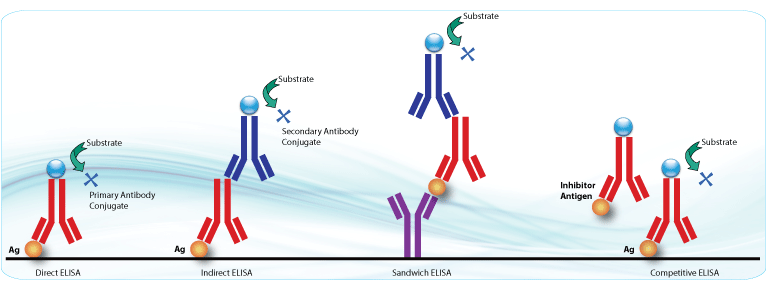
Peptides can be used for ELISA assay. A peptide-based indirect ELISA was used to screen a population of 40 Multiple sclerosis patients and 39 healthy controls. The encephalitogenic myelin oligodendrocyte glycoprotein (MOG)35–55 synthetic peptides were synthesized by LifeTein.
LifeTein’s Synthetic Peptides for ELISA
All MOG peptides or Mycobacterium avium subspecies paratuberculosis (MAP) peptides were synthesized at >90% purity by LifeTein to make sure the ELISA results are clean and consistent. The plates were coated with peptides. After overnight incubation, the plate was blocked, rinsed, and late react with antibodies according to the protocol. In silico analysis identified two peptides belonging to MAP and BCG, which share sequence homology with MOG(35–55). The peptide-based indirect ELISA data showed that sharing of highly conserved linear amino acidic sequences is necessary to elicit antibody-mediated cross-reactivity.
These findings concluded that the presence of MOG (35–55)-specific antibodies in multiple sclerosis pathogenesis. This can be used as a diagnostic biomarker in multiple sclerosis.
… All peptides were synthesized at N90% purity commercially (LifeTein, South Plainfield, NJ 07080 US). Purified peptides were prepared as [10 mM] stock solutions, and were stored in single- use aliquots at −80 °C. 2.3. ELISA …
Peptide library is increasingly used to define antibody epitopes and substrate specificities of protein kinases. For epitope mapping, overlapping peptides are made to span the antigenic protein sequence. The antigenic determinant recognized by a monoclonal antibody can then be screened and defined. The alanine scanning method can also be used to assess that residue’s contribution to antibody binding and to determine which substitutions affect antibody recognition (mutational analysis). Unrelated synthetic peptides can be used to evaluate the antibody cross-reactivity.
Peptide by LifeTein Cited in Cell
Overlapping peptides from LifeTein were used to map the region of Fragment 3 by epitope mapping of anti-Fzd2 antibody. This anti-Fzd2 antibody was found to reduce tumor growth. Wnt signaling plays a critical role in colorectal cancer. Researchers found that Wnt receptor Frizzled2 (Fzd2) and its ligands Wnt5a/b are elevated in metastatic liver, lung, colon, and breast cancer cell lines. Their high level expression correlates with markers of epithelial-mesenchymal transition (EMT). By epitope mapping using synthetic peptides from LifeTein, the researchers mapped the epitope to a specific region. The antibody to Fzd2 was found to reduce cell migration and invasion. Targeting this pathway may provide a cure for patients with tumors expressing high amount of Fzd2 and Wnt5a/b. We have developed an antibody to Fzd2 that reduces cell migration and invasion and inhibits tumor growth and metastasis in xenografts. We propose that targeting this pathway could provide benefit for patients with tumors expressing high levels of Fzd2 and Wnt5a/b.
Synthesis of multiple antigenic peptides: strategies and limitations
Dendrimeric platforms such as multiple antigenic peptides (MAP) can be synthesized either entirely by solid-phase methods (SPPS, direct approach) or by conjugation in SPPS-made building blocks (indirect approach).
Synthesis of Multiple Antigenic Peptides
MAP peptide synthesis
http://www.ncbi.nlm.nih.gov/pubmed/21391284
SPPS is the preferred method by LifeTein. The synthesis approach requires a branched poly-lysine core. Each branch is elongated into the corresponding epitope by stepwise SPPS. The disadvantage of this approach is that the synthetic errors could happened and cause microheterogeneity in the final materials. However the cost is lower and less time-consuming than the indirect approach. For very long linear peptides, it is more advantageous to use the SPPS method.
The MAP synthesis may not always meet with success. The solubility of the peptide epitope can also become an issue and is difficult to predict for long epitopes. It is recommended to carefully design and analyze the linear epitope before MAP synthesis.
Studies showed that synthesis with Ahx linker in the lysine core had better isolated yield. It is possible that the flexibilizing effect of Ahx helps in keeping peptide chains properly solvated during synthesis, preventing aggregation and hence increasing the amount of viable growing peptide sequences.
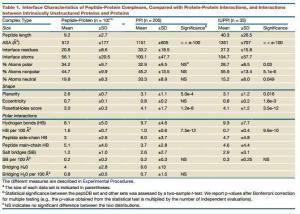
Peptide protein binding strategies: Structure, Volume 18, Issue 2, 188-199, 10 February 2010
Peptide-Protein Binding
Highlights
After binding its partners, most peptides do not introduce any conformational changes
The interfaces of peptide-protein have more hydrogen bonds
The peptide hotspots are important for the binding
Peptides prefer to bind in the largest pockets on the protein surface
LifeTein is pleased to offer a free, comprehensive web-based peptide analysis tool. This tool will allow your research team to overcome common difficulties inherent in protein analysis and peptide antigen design.
Proteins and most naturally occurring peptides are composed of amino acids in the L-configuration. However, D-amino acids have been detected in a variety of peptides synthesized in animal cells. Examples include opiate and antimicrobial peptides from frog skin, neuropeptides from snails, hormones from crustaceans, and venom from spiders. These D amino acid peptides are considered to be the most promising alternative for anticancer, anti-inflammatory, antimicrobial, and delivery agents.
About D-Amino Acid Peptides
The design of all-D-peptides has been applied to increase bioactive peptides’ resistance to endogenous enzymes, as well as their bioavailability. Retro-inverso peptides are obtained by replacing the standard L-amino acid residues with the corresponding D-amino acids and reversing the direction of the peptide backbone. Therefore, the original spatial orientation and the chirality of the side chains is unchanged. This results in a non-complementary side chain topochemistry between the analog and the parental L-peptide. The significantly improved biostability of D-peptides usually leads to longer in vivo circulation half-time, making the D-peptide based drug delivery system more attractive and efficient than their L-peptide counterparts.
Success has been achieved immunologically in using retro-inverso peptides toward antigenic mimicry of their parent l-peptides. It was found that the retro-all-d-peptide isomer of p53(15–29), like its parent l-peptide, adopted a right-handed helical conformation in the complex. However, in some cases, the retro-inverso isomers are significantly inferior to their parent l-peptides. The low cellular uptake of D-peptides remain an unmet challenge.
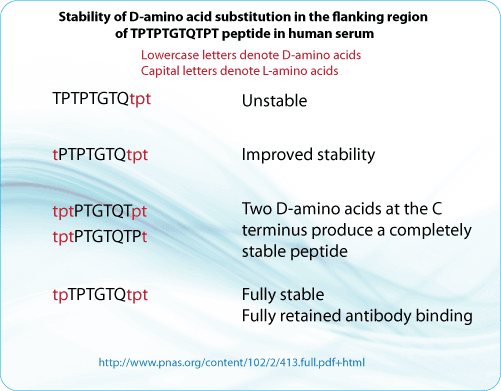
So the best way is to insert some key D amino acids into the peptide sequence. For example, some pharmaceutical important peptide antibiotics such as gramicidins, actinomycins, or bacitracins incorporate D-amino acids into the drug design. The assemblies of D-peptides deserve further exploration and may lead to more surprises.
D amino acid peptide with high stability
See more details from here: http://lifetein.com/Peptide-Synthesis-D-Amino-Acid.html
Reference: http://www.pnas.org/content/102/2/413.full.pdf+html
Google+
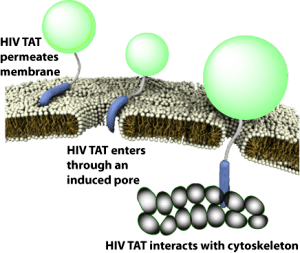
Cell-penetrating peptides (CPPs) such as the HIV TAT peptides are able to enter cells by direct translocation and endocytosis. Click here to see details about the CPP: http://lifetein.com/Cell_Penetrating_Peptides.html
About Cell-Penetrating Peptides
Cell Penetrating Peptides
The following table shows a selection of currently known CPPs, their origins, and sequences.
Targeted Drug Melts Fat in Obese Monkeys Currently, only two Food and Drug Administration (FDA) approved drugs for weight loss are available in the United States: the appetite suppressant phentermine and the inhibitor of fat absorption orlistat.
Peptide Drug for Obesity
An MD Anderson group designed a new peptide drug: CKGGRAKDC-GG-D(KLAKLAK)2 (adipotide). This is a synthetic peptide that triggers cell death. These data showed that the peptide might be helpful in treating obesity in humans. The MD Anderson group used a peptide library to screen and identify regions that bind to specific vascular cells. The interaction identified will be used as effective drugs to target particular protein functions. This video explains factors that have contributed to the obesity epidemic.
Cell-penetrating peptides (CPPs) have the ability to enter a cell’s plasma membrane independent of a membrane receptor. Attached to a CPP, therapeutic cargo could be delivered to an intracellular target, thus overcoming the entry restrictions set by the plasma membrane.
Peptide Synthesis & Cell Penetration
The cationic CPPs interact with negatively charged head groups of lipids directly in the plasma membrane through electrostatic interactions. The increased local peptide concentration at the membrane surface will cause a transient destabilization of the lipid bilayer and lead to cell entry. The hydrophobic interactions, especially facilitated by the presence of tryptophan residues, may be important for the CPP-membrane interaction and cellular internalization.
Advancements in Peptide Vaccine Research: Tackling Pancreatic Cancer and Beyond
The tragic loss of Apple’s co-founder, Steve Jobs, to pancreatic cancer in 2011 underscored the urgent need for effective cancer treatments. Pancreatic cancer, known for its lethality and as the fourth leading cause of cancer deaths globally, highlights the critical need for advancements in medical research, particularly in the realm of immunotherapy.
One promising avenue is the development of synthetic-peptide-based vaccines. These vaccines are engineered to stimulate T cell immunity, offering potential in both preventing and treating various diseases, including malignant disorders like cancer. Peptide vaccines have shown promise in generating antigen-specific responses in pancreatic cancer, targeting the unique differences between healthy and cancerous cells.
A notable target in cancer cells is Mucin 1 (MUC1), a glycoprotein that differs in structure between normal and cancerous cells. Peptide vaccines targeting MUC1 have demonstrated the ability to elicit an immune response, including the production of antibodies against its unique peptide sequences. Clinical trials are currently exploring the potential of MUC1 peptide vaccines in cancer immunotherapy.
Moreover, cancer cells exhibit distinct characteristics in terms of telomere-building enzymes and vascular endothelial growth factors (VEGF). For instance, the GV1001 peptide, a telomerase-based vaccine, has shown promising results in inducing an immune response in pancreatic cancer patients. Similarly, a VEGFR2–169 peptide vaccine, used alongside chemotherapy, has extended median survival in advanced pancreatic cancer patients, with further studies underway.
Tailoring peptide vaccines to individual patients is another emerging strategy. In a pilot study, patients with pancreatic and colorectal cancers received vaccines containing K-Ras peptides specific to their cancer mutations, leading to prolonged survival and significant T-cell responses in a subset of patients.
However, the journey in peptide vaccine research is not without challenges. The inherent low immunogenicity of peptides poses a hurdle, though various strategies, such as modifying key residues and combining peptides with more immunogenic substances, are being explored to enhance their effectiveness.
The future of peptide vaccines in cancer treatment requires a deep understanding of how cancers evade immune detection and how to counteract these mechanisms. Ongoing research aims to optimize peptide dosage, vaccine formulation, and identification of the most effective T cell epitopes, crucial for the success of future clinical trials.
In the realm of infectious diseases, the 2009 swine flu outbreak caused by the H1N1 virus strain brought to light the potential of peptide-based treatments. Researchers have identified a killer decapeptide (KP) with potent action against the influenza A virus. This peptide, derived from an anti-idiotypic antibody, has shown promising results in reducing viral levels and improving survival rates in animal models.
The versatility of synthetic peptides extends beyond cancer treatment to infectious disease control, with ongoing research in using peptides for HIV-2 detection and antibody production. The growing number of therapeutic peptides in clinical use and trials underscores their potential as a novel therapeutic strategy in various clinical settings. The question “Will killer peptide offer new therapy against swine flu H1N1 virus?” remains at the forefront of scientific inquiry, reflecting the ongoing efforts to harness peptide-based solutions in combating both infectious diseases and cancer.
The exploration of peptides in obesity control further illustrates their diverse therapeutic potential. Research has shown that certain peptide hormones, like glucagon and GLP-1, can be engineered to target multiple body mechanisms for weight normalization. High-potency glucagon-based co-agonist peptides, for instance, have demonstrated significant efficacy in reducing obesity and improving glucose tolerance in animal studies. This represents a promising direction in the quest for effective weight management therapies.
As the field of peptide research continues to evolve, it offers a beacon of hope in addressing some of the most pressing health challenges of our time, from cancer and infectious diseases to obesity. The versatility and specificity of peptides make them an attractive option in the therapeutic landscape, paving the way for more targeted and effective treatments across a broad spectrum of diseases.
References:
G. Conti, W. Magliani, S. Conti, L. Nencioni, R. Sgarbanti, A.T. Palamara, L. Polonelli. “Therapeutic activity of an anti-idiotypic antibody-derived killer peptide against influenza A virus experimental infection.” Antimicrobial Agents and Chemotherapy, 52. 12: 4331-4337
Day JW, etc. “A new glucagon and GLP-1 co-agonist eliminates obesity in rodents.” Nat Chem Biol. 2009 Oct;5(10):749-57. Epub 2009 Jul 13.
This comprehensive view of peptide vaccine research and therapeutic peptides underscores their significant role in advancing medical science and offers a glimpse into the future of healthcare.
To provide the best experiences, we use technologies like cookies to store and/or access device information. Consenting to these technologies will allow us to process data such as browsing behavior or unique IDs on this site. Not consenting or withdrawing consent, may adversely affect certain features and functions.
Functional
Always active
The technical storage or access is strictly necessary for the legitimate purpose of enabling the use of a specific service explicitly requested by the subscriber or user, or for the sole purpose of carrying out the transmission of a communication over an electronic communications network.
Preferences
The technical storage or access is necessary for the legitimate purpose of storing preferences that are not requested by the subscriber or user.
Statistics
The technical storage or access that is used exclusively for statistical purposes.The technical storage or access that is used exclusively for anonymous statistical purposes. Without a subpoena, voluntary compliance on the part of your Internet Service Provider, or additional records from a third party, information stored or retrieved for this purpose alone cannot usually be used to identify you.
Marketing
The technical storage or access is required to create user profiles to send advertising, or to track the user on a website or across several websites for similar marketing purposes.